
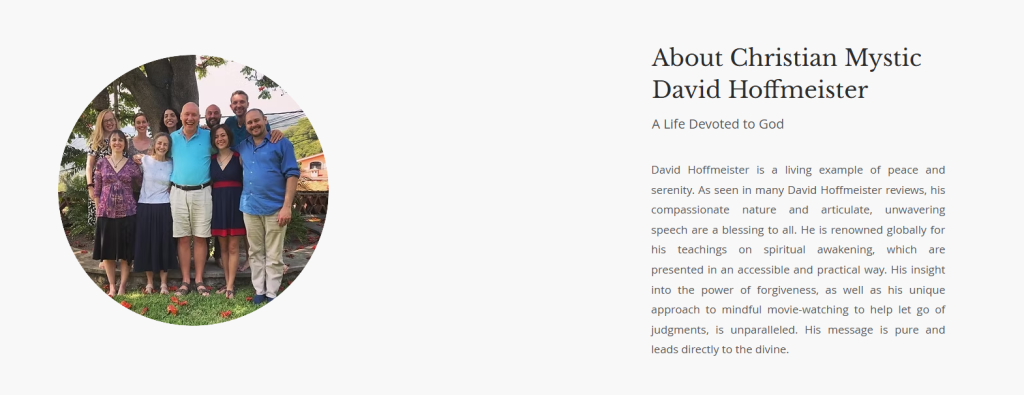
The topic david hoffmeister controversy is widely discussed among readers who explore modern spiritual teachings and non-dual philosophy. David Hoffmeister is known for his association with A Course in Miracles (ACIM) and his focus on forgiveness, inner peace, and perception-based understanding of reality.
However, the word “controversy” in this context is not linked to any confirmed issue. Instead, it reflects how different people interpret his teachings in different ways depending on their beliefs, understanding level, and personal experience.
📊 Overview of Public Understanding
| Aspect | General Interpretation |
|---|---|
| Teaching Style | Spiritual and experiential |
| Core Focus | Forgiveness and inner peace |
| Audience Response | Mixed interpretations |
| Main Discussion | Philosophical differences |
🧠 Understanding His Teaching Approach
David Hoffmeister’s teachings mainly focus on inner transformation rather than external rules or traditional religious structure.
Key ideas include:
- Forgiveness as a mental release
- Reality shaped by perception
- Separation as illusion
- Inner peace as natural state
These ideas are often understood differently by different readers.
🌐 Why People Discuss “Controversy”
The keyword david hoffmeister controversy appears mainly because:
1. Different Interpretations
Some people understand his teachings in a symbolic way, while others interpret them more literally.
2. Abstract Language
His teachings use philosophical and non-dual concepts that are not always easy to interpret in a single fixed meaning.
3. Online Discussions
People share different opinions across blogs, forums, and videos, which creates mixed impressions.
📌 Supportive Viewpoint
Many followers and readers describe his teachings in a positive way:
- Helps in emotional clarity
- Encourages forgiveness mindset
- Promotes inner peace
- Provides a different way of thinking about life
They often feel that the teachings are more about experience than theory.
📌 Critical or Neutral Viewpoint
Some readers have a more neutral or questioning approach:
- Concepts are abstract
- Hard to interpret literally
- Depends on personal belief system
- Not aligned with traditional frameworks
This difference in understanding creates discussion and debate.
📊 Comparison Table
| Perspective | View on Teachings |
|---|---|
| Supporters | Transformational and peaceful |
| Neutral | Philosophical and interpretive |
| Critics | Abstract and subjective |
🧩 Role of Interpretation
One important factor is that his teachings are not fixed instructions. They are more like philosophical ideas that require personal reflection.
Because of this:
- Each reader understands differently
- Meaning changes based on mindset
- Experience plays a big role
🌍 Public Perception Pattern
In general, people approach his teachings in three ways:
1. Experiential Readers
They focus on how the teachings make them feel internally.
2. Analytical Readers
They try to logically understand the philosophy.
3. Skeptical Readers
They question the concepts and prefer structured explanations.
📌 Key Insight
The discussion around david hoffmeister controversy is mostly based on interpretation differences rather than any confirmed factual issue. His teachings are philosophical in nature, which naturally leads to varied understanding among different audiences.
❓ FAQ
1. What does “David Hoffmeister controversy” mean?
It refers to different interpretations and discussions about his teachings, not a confirmed issue.
2. Is there any verified controversy?
No verified controversy is associated with him based on available information.
3. Why do people discuss his teachings differently?
Because his teachings are philosophical and open to interpretation.
4. What is his main teaching focus?
Forgiveness, perception shift, and inner peace.
5. Is his teaching part of traditional religion?
No, it is based on non-dual spiritual philosophy and A Course in Miracles.
